
A Major Upgrade for Salmon Habitat is Underway in Lake Sammamish State Park!

The Mountains to Sound Greenway Trust recently completed its biggest restoration project yet, and one of the largest in Lake Sammamish State Park’s history: in-stream restoration within Lower Issaquah Creek. We’ve been working with numerous partners and thousands of volunteers for more than two decades to improve this important salmon habitat. We’ve reached a major milestone, but there’s still more to do!
Watch the Full-Length Documentary
Short on time? Check out the trailer here!

Volunteers Needed!
We are recruiting volunteers to support tree planting for this project, as well as other trail work and habitat restoration events across the Greenway! Learn more and sign up to volunteer below.
Why Issaquah Creek Needs Help

Since time immemorial, Issaquah Creek has supported salmon, wildlife, and people. However, decades of farming, logging, and development have caused big changes in the creek – making it straighter than it should be, removing natural logjams, and cutting off its floodplains. These changes have disrupted water flow, reduced habitat quality and complexity, and severely hurt Chinook salmon populations, which are now listed as threatened under the Endangered Species Act.
With a salmon hatchery just upstream, literally millions of juvenile salmon utilize this stretch of creek at multiple stages of their life cycle. After hatching, young fish need slow-moving water with shelter to grow, rest, and hide from predators. These safe rearing areas are less common now in Issaquah Creek, making it harder for salmon to survive. This project will help the creek get back to its natural processes, giving young salmon a better chance to survive their journey along the creek and through Lake Sammamish, Lake Washington, and the Ballard Locks.
Climate change is making this work even more important. Rising temperatures, lower summer water levels, and increased winter flooding make life more challenging for salmon. By restoring floodplains, adding large wood, and planting native trees, we’re creating a healthier creek – not just for salmon, but for people and other wildlife too.

Issaquah Creek was like a house with only hallways—no places to rest or eat. This project will help rebuild a real home for them!
A Community Effort to Restore Issaquah Creek

Issaquah Creek runs through parks and protected lands today, but it wasn’t always this way. In the 1800s and 1900s, much of the creek was privately owned, leading to major forest habitat loss. By the 1990s, the damage was clear—seasonal flooding of downtown Issaquah, fewer salmon, and reduced creek access for both wildlife and residents.
In response, local leaders created a shared plan to help salmon recover, forming the Lake Washington/Cedar/Sammamish Watershed (WRIA 8) Salmon Recovery Council in 1998. Since then, the Greenway Trust, along with city officials, Tribes, businesses, and volunteers, have worked together to restore this vital ecosystem.
A key first step was securing public ownership of important creekside lands, followed by large-scale habitat restoration. Healthy streams need cool, clean water, stable banks, and places for fish to rest and spawn. Native trees and shrubs help by shading the water, stabilizing the banks, and filtering pollutants before they reach the creek. Without a healthy forest, Issaquah Creek struggles to support salmon.
Over the past 20 years, the Greenway Trust and partners have:
- Removed introduced species like blackberry and ivy, which crowd out native plants
- Planted 50,000+ native trees and shrubs to rebuild a healthy forest along the creek
- Engaged nearly 20,000 volunteers, who have contributed over 70,000 hours to restoration in the park

These actions have transformed much of the creek’s surrounding habitat, improving water quality and creating better conditions for fish and other wildlife. But for salmon to thrive, we must also restore the creek itself.
Taking the Next Big Step: In-Stream Restoration

After decades of planning, we completed an in-stream restoration project at Issaquah Creek in the fall of 2025. By restoring natural processes, Issaquah Creek will heal over time, ensuring healthier waters for fish, wildlife, and future generations. Now, millions of juvenile Chinook and other salmonid species have a better place to spawn, grow, and survive.
How We’re Improving In-Stream Creek Conditions:
- Reconnected the creek to its floodplain to improve water quality and provide habitat where juvenile salmon can take refuge and rest, no matter how high the creek is flowing.
- Added 500+ pieces of large wood into the creek to create deeper pools with protective cover and slow-moving areas where salmon can rest.
- Placed an additional 300+ pieces of large wood on top of bank to increase habitat complexity out of water
- Reopened historic side channels, providing more space for fish to rest and grow, and redirected water into side channels to help shape and deepen the creek.
- Planting 10,000-15,000 native trees and shrubs within year one that will support wildlife and provide shade to keep the water cool.
- Providing more habitat complexity at various water levels and throughout the year
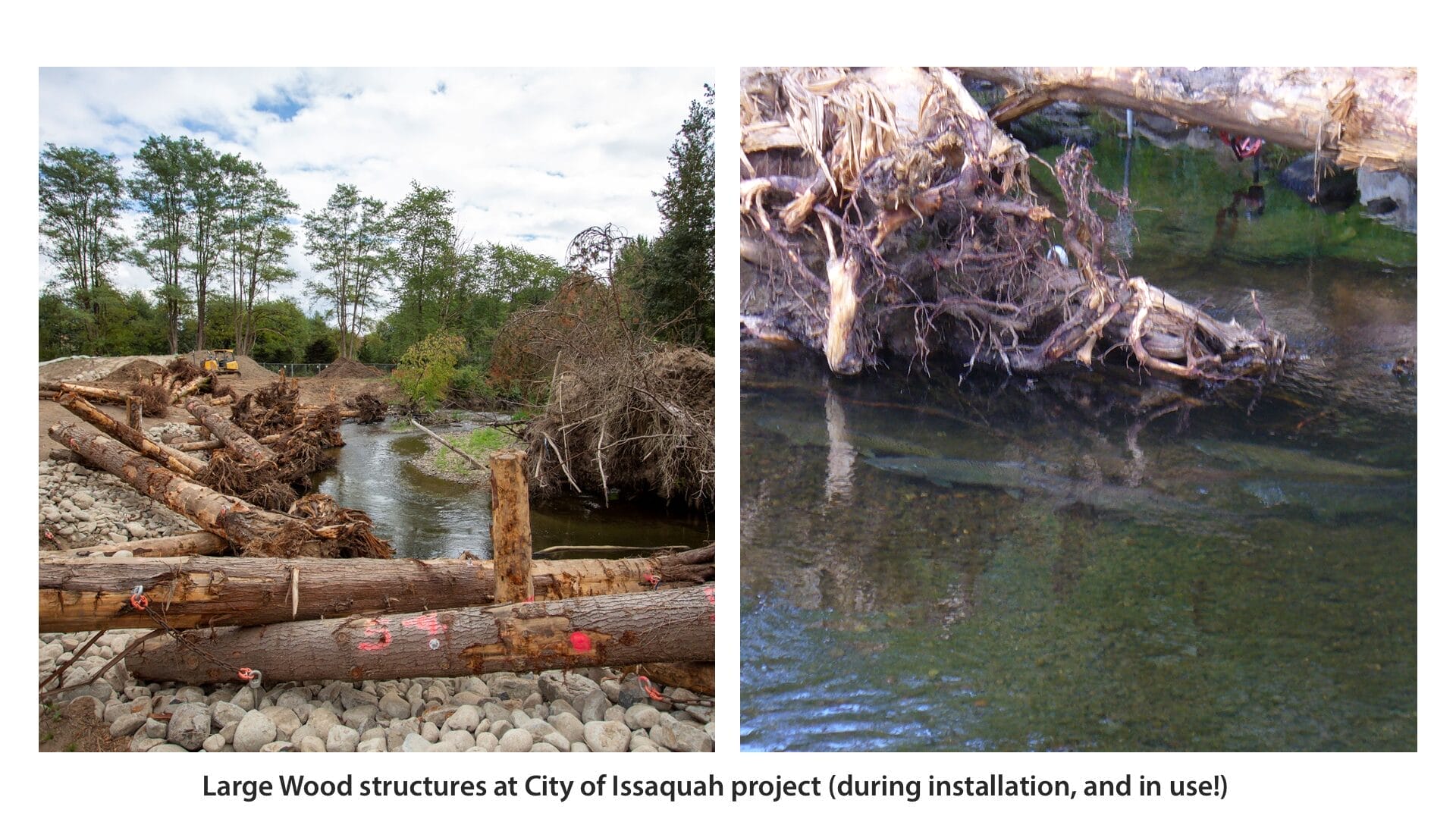
This project marks completion of nearly all planned restoration in lower Issaquah Creek under the 2005 and 2017 Chinook Salmon Conservation Plans. It also builds on 40+ years of restoration work by the City of Issaquah, including projects at Confluence Park, Salmon Run, Squak Valley Park, and previous in-stream restoration efforts that provided valuable insights for this project.

Using Adaptive Management to Monitor Issaquah Creek
Creeks are living systems that are forever changing. Adaptive management means that we are committed for the long term, constantly learning as natural processes take place and the system evolves. In the last six years, we’ve had approximately three 10-year flood events that have had major impacts on our region. The most recent one in December of 2025 caused catastrophic levels of flooding throughout Washington and is estimated to be one of the largest floods on record in Issaquah. With peak flows reaching just under 2,470 cubic feet per second in Issaquah Creek, this storm put the project’s newly built structures to the test earlier than expected, and they passed with flying colors.
Preliminary data shows that new restoration features caused surging waters to slow down and spread out into the floodplain and newly reopened side channel. That data revealed that the gauge height of water levels in Issaquah Creek was lower than in previous major floods at similar flow levels. And it showed that the reconnected oxbow and side channels were activated, filling with water and capturing more wood. Though Lake Sammamish State Park is historically a wetland and prone to flooding, the Sunset Beach parking lot and other areas experienced less impact during the most recent flood compared to the last flood of comparable size that happened in 2022. While the last 10-year flood of this size occurred only five years ago—reflecting changing climate patterns—the extensive hydraulic modeling used to place hundreds of interlocking trees into the creek and its banks still largely performed as predicted. That’s due to the power of valuable insights gleaned from decades of work by our partners who completed restoration projects along Issaquah Creek, long before crews laid trees on its banks.

Together, all the projects piece together into a healthier system that works in tandem to slow stormwaters and provide refuge for salmon through multiple life stages. As nature continues to shape the creek, we will monitor its changes and continuously work with our community of partners and volunteers to strengthen its banks with native plants—so the creek can become progressively healthier ahead of the next storm.
Get Involved!
Restoration is a long-term investment in our environment, salmon recovery, and future generations. Be part of the effort!

Volunteer
Help care for native plants at our nursery in Lake Sammamish State Park, remove non-native weeds, or join future tree planting events. Click to learn more and sign up!

Support
Raise awareness by sharing this project with your community and speaking up for work that protects salmon and watershed health. You can also support future habitat restoration and maintenance by making a donation to our nonprofit organization.
Project Support
Thank you to the following groups for their role in making this project possible!
Project Team:
- Mountains to Sound Greenway Trust
- Washington State Parks & Recreation Commission
- Northwest Hydraulic Consultants
- Natural Waters, LLC
- Facet
- BCI Contracting, Inc
Contributors:
- Washington State Parks and Recreation Commission (Landowner and Partner)
- Washington State Recreation and Conservation Office and Salmon Recovery Funding Board
- Muckleshoot Indian Tribe & Muckleshoot Indian Tribe Fisheries Department Staff
- Snoqualmie Tribe & Environmental & Natural Resources Department Staff
- Tulalip Tribes & Environmental Division Staff
- Confederated Tribes and Bands of the Yakama Nation & Yakama Nation Fisheries Department Staff
- Congresswoman Kim Schrier (WA-08)
- City of Issaquah
- Washington Department of Fish and Wildlife
- Washington State Salmon Recovery Funding Board and Washington State Recreation & Conservation Office
- King County Flood Control District
- King County Kokanee Work Group
- King County Water and Land Resources Division
- Lake Washington/Cedar/Sammamish Watershed (WRIA 8) and WRIA 8 Technical Committee
- Friends of Lake Sammamish State Park
- Trout Unlimited
- The Boeing Company
- Carter Subaru and Carter Motors
Funding: *
This project is funded in part by the Lake Washington/Cedar/Sammamish Watershed (WRIA 8) and the King County Flood Control District Cooperative Watershed Management Grant Program, the King County Flood Control District’s Flood Reduction Fund, the Washington State Salmon Recovery Funding Board (SRFB) via WRIA 8 and the Washington State Recreation and Conservation Office, the National Fish and Wildlife Foundation, the United States Environmental Protection Agency with support from Congresswoman Kim Schrier (WA-08), and contributions from The Boeing Company.
* Recent funding cuts, freezes, and delayed payments on federally funded grants and agreements have created uncertainty that may lead to scope or timeline adjustments to this project. The team will be assessing these impacts regularly and making decisions to maximize project outcomes with the resources available.
Learn More
Project Coverage in the Seattle Times
Issaquah Creek Restoration Final Design Report
StoryMap: Ecological and Cultural Significance of Salmon in the Greenway NHA