How a Gravel Mine Built the Region
and Saved a Forest
The Mountains to Sound Greenway Trust is committed to protecting the long-term forested character of the Interstate 90 corridor through the Cascades. And the challenge of keeping significant, connected forest lands in the face of powerful urban growth has led the Greenway Trust into areas where many conservation groups typically would not tread.
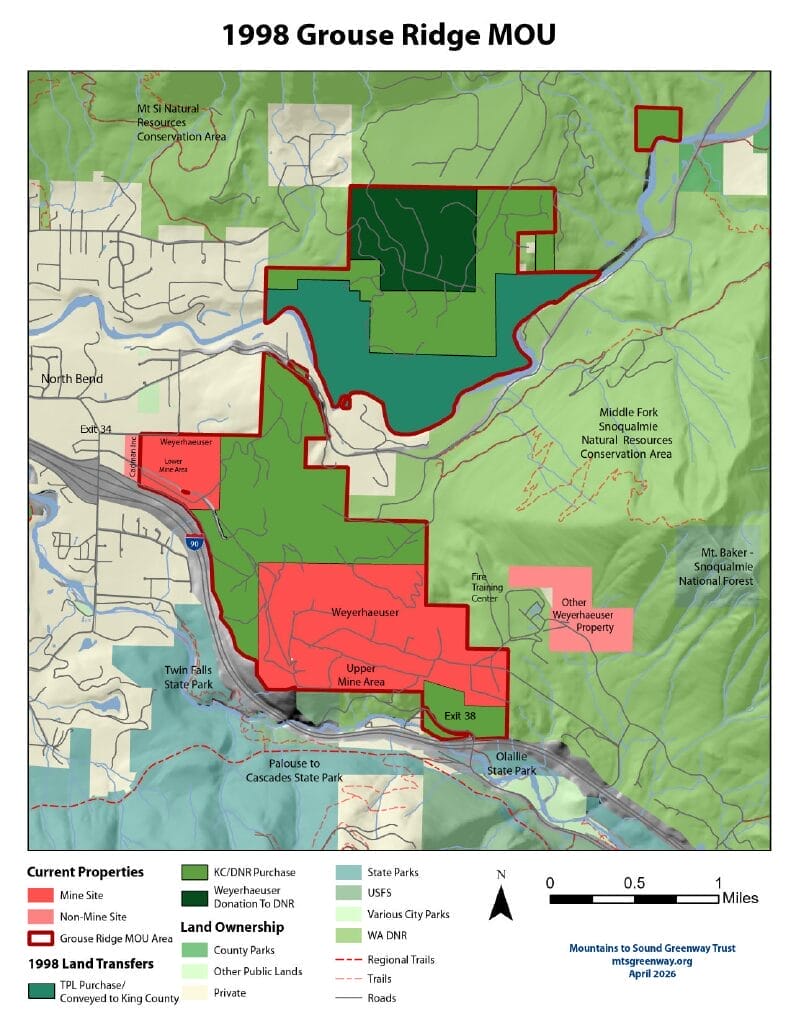
In 1998, Jim Ellis, civic leader and President of the Mountains to Sound Greenway Trust, negotiated an innovative compromise for land use at Grouse Ridge, just east of North Bend in the Snoqualmie Valley, which led to permanent public conservation of thousands of acres of forestlands and much-needed gravel for a rapidly growing population.
1998 Grouse Ridge Agreement
- A landmark agreement, brokered by the Mountains to Sound Greenway Trust that continues to deliver massive economic and environmental benefits
- Gravel to build infrastructure throughout the region during decades of extraordinary population growth and economic development
- Permanent forest conservation of the entire Grouse Ridge for timber, wildlife, clean air, clean water, and recreation.

The land mass of Grouse Ridge is made up of two massive gravel deposits on both sides of the river at the gateway to the Middle Fork Snoqualmie River Valley. Public agencies could never fund the outright purchase of these lands from the landowner Weyerhaeuser, estimated to be worth $200 million in gravel in the 1990s. The property has long been zoned for forestry and gravel mining.
Weyerhaeuser, as well as King County, the Washington State Department of Natural Resources, The Trust for Public Land, and the Greenway Trust, came together to creatively protect thousands of acres of forest land while providing gravel for rapid construction and growth in the Puget Sound area. This innovative agreement conserved ecologically sensitive lands along the Middle Fork Snoqualmie River, while extracting gravel closer to Interstate 90 and a major freeway interchange for more efficient transport.
Weyerhaeuser owns the land and contracted with Cadman, Inc. (now Heidelberg Materials) to operate the mine. The Greenway Trust and partner organizations agreed to support the permit application for the mine operation if the mine could be hidden from the eyes and ears of neighbors and travelers and would protect air and water resources and the natural environment around the site.
Cadman hired Jones and Jones, landscape architects, to design a mine plan that meets these high standards. The mining areas themselves are shaped like bowls from the top of the ridge so they are less visible from any side. A conveyor system moves material from the upper site to the lower site, reducing the need for truck transport and allowing for processing with a minimal footprint.

As one might imagine, this agreement was not without controversy at the time. But the public benefits of permanent forest conservation for timber, wildlife, clean air, clean water, and recreation combined with gravel to build infrastructure during a time of extraordinary population growth resulted in the Greenway Trust and partner organizations moving forward with the 1998 Grouse Ridge Agreement that continues to govern the management of these lands.
And the best is yet to come – when mining is complete, (est. 2050-2060 according to mine operators) the land (roughly 650 acres of mine sites) will be revegetated and donated to the Washington State Department of Natural Resources in trust for King County, returning this land to publicly-owned forest and revenue generation for the public good, in perpetuity.
The Grouse Ridge Agreement was visionary because it recognized both the long-term importance of gravel production for a growing region—which has continued for nearly 30 years and remains ongoing—and the need for permanent forest protection. The forest protection and restoration commitments established in the 1998 Grouse Ridge Agreement were intended to help mitigate the environmental impacts of a major gravel mining operation. Sustaining the economic benefits that continued gravel mining provides to the region requires that the forest restoration and protection commitments, as tied together in the Grouse Ridge Agreement, are upheld.
Published April 2026

Conveyer belt moves gravel (and generates power) from upper to lower mine site for processing Lower mine site processes gravel for transport Gravel extraction infrastructure on the upper mine site


Related Links:
Grouse Ridge Agreement: 1998 Memorandum of Understanding for the Middle Fork / Grouse Ridge Project
“Tough Trade-Offs: Forests, Gravel and Growth” Editorial by Jim Ellis in the Seattle Times, 1998